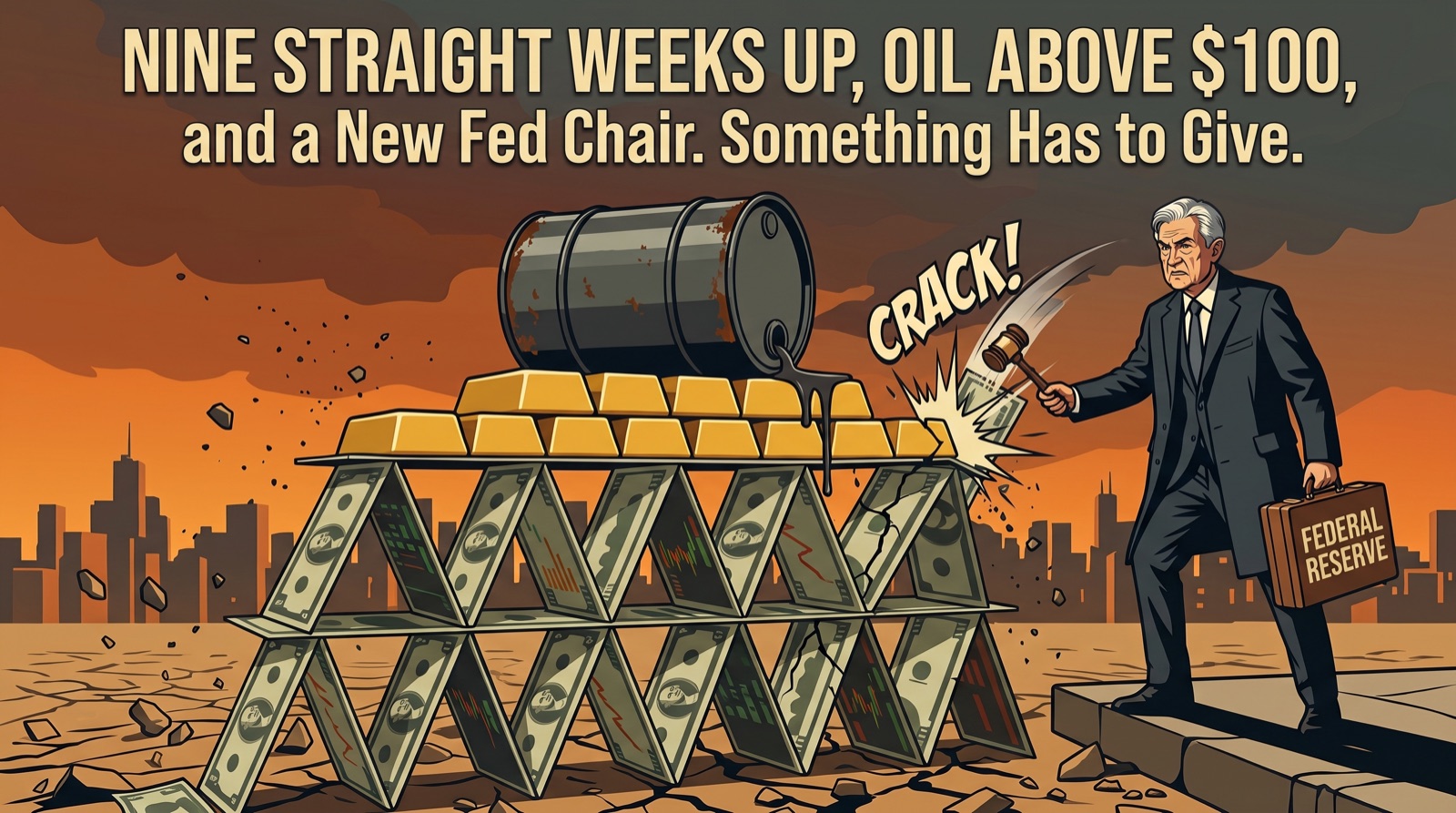
The S&P 500 closed May at roughly 7,580, a record, on a nine-week winning streak. Nasdaq is up double digits for the year. Every dip since the spring has been bought. I am not going to argue with the tape, but I am going to argue with the story the tape is telling itself.
That story is: the war premium in oil is fading, the Fed's next move is a cut, and AI earnings will carry the second half. I think one of those three legs is rotten, and it is the one the whole rally leans on hardest.
The Inflation Math Has Already Been Done
Crude has traded above $100 for most of the second quarter since the late-February operation against Iran. Brent was still around $106 a week ago, even after a ceasefire-driven pullback. The May CPI print lands on June 10, and energy is going to do what energy does to a headline number when it has spent two months at that level. Headline inflation is going to look ugly. The April print already had a four-handle in the neighborhood.
Here is what matters: the Fed does not get to look through this one the way it looked through 2022's energy spike, because core has not come down enough to give it cover, and the labor market has not cracked. Weekly claims are low. The April payroll number was revised up. Everything the doves need to justify a cut is missing.
Warsh Is an Unknown, and Markets Hate Unknowns
Kevin Warsh was sworn in on May 22. The June 16 to 17 meeting is his first as Chair. He inherits a funds rate of 3.50% to 3.75% that has not moved since December, a dot plot from March that still penciled in cuts, and a headline inflation rate moving in the wrong direction.
Warsh built his public reputation on skepticism of easy money and a large Fed balance sheet. A first-meeting Chair does not want to look soft with CPI accelerating. My base case is a hold with a dot plot that drifts hawkish, and I would not rule out a meaningful minority of the committee penciling in a hike for 2026. Fed funds futures do not price that. That gap is the trade.
This Week's Two Tests
- Broadcom, Wednesday after the close. The consensus number is beatable. The whisper on AI semiconductor guidance is not. AVGO is priced for perfection, and its custom-silicon customers are the same hyperscalers now openly discussing how to fund 2026 capex. A guide that merely meets consensus will be treated as a miss.
- May payrolls, Friday. Consensus sits near 80,000. Given the April revision and the claims data, I think the risk is skewed higher, and a strong number is bad news for this market: it lifts the 10-year, kills the cut narrative, and hits the longest-duration names hardest. A print above 150,000 would be a genuine problem for the Nasdaq.
How the Setup Looks
What I Am Watching This Week
| S&P 500 level that breaks the streak | Below 7,500 on a weekly close |
| 10-year yield that pressures multiples | Above 4.50% |
| May payrolls, hawkish threshold | > 150,000 |
| Broadcom AI revenue guide, needed to hold the stock | > $17B for the quarter |
| Brent, level that keeps headline CPI above 4% | > $90 through June |
The rational move into last week's records is to lighten the highest-multiple AI exposure and redirect it to two places: memory, where Micron and Sandisk sell a physical product into a shortage rather than a promise, and short-duration Treasuries, which now pay more than 4% for taking almost no risk. Core semiconductor exposure still makes sense. Anything that needs a rate cut to justify its multiple does not.
My Take
The rally is real, but the cut narrative underneath it is not. With oil above $100 for a quarter, a strong labor market, and a new Chair who cannot afford to look dovish, I expect June's macro data to push yields higher and the Fed's dots hawkish.
Playbook: favor core semis, lighten long-duration AI software and platform names, add memory and short Treasuries. A payroll print above 150,000 on Friday is the signal to cut further.