Thursday's June jobs report showed payrolls up just 57,000 against expectations near 115,000, with the prior two months revised down by 74,000. Unemployment fell to 4.2%, but only because participation dropped to its lowest level since 2021. Brent crude, which traded above $100 for most of the spring, closed the holiday week near $69 on the US-Iran memorandum.
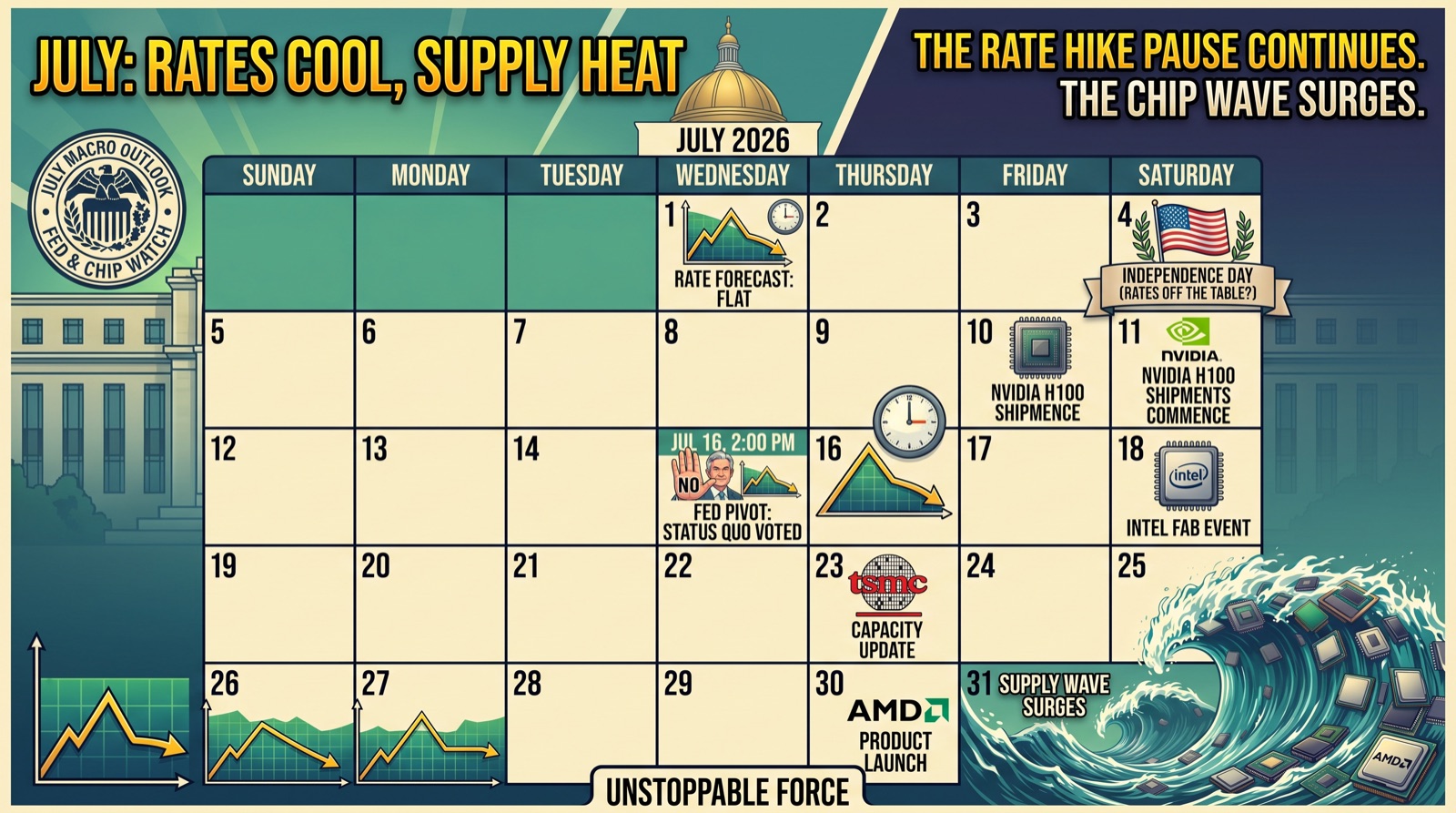
Put those two facts together and the scenario I have been hedging against since June 1, a Warsh Fed that hikes into an energy-driven inflation spike, has lost most of its fuel. The July 29 meeting is now a hold-versus-hike debate that leans hold. That is good for equities in general. It has not been good for semiconductors, and this week explains why.
Good News Is Being Sold, and It Is Not About Rates
Micron reported the best quarter in memory history two weeks ago: $41.5 billion of revenue against its own $33.5 billion guide and an August-quarter guide of $50 billion. The stock rose 15.7% the next morning and has given back all of it and more. Nvidia is down roughly 18% from its June high. Sandisk peaked at $2,335 on June 25 and is falling fast.
Rates do not explain that. Supply does. In the next five trading days the market has to absorb Samsung's preliminary second-quarter numbers tomorrow, which will show something close to a record operating profit and, more importantly, a capital expenditure plan sized to match; SK Hynix's American depositary listing on Friday, which is expected to raise more than $25 billion, the largest ADR offering ever; and Wednesday's minutes of the June Fed meeting, which will remind everyone how hawkish the dots were before the jobs data.
I wrote on June 8 that the AI trade had turned into a supply-of-paper story. That was about the hyperscalers raising equity. It now applies to the memory makers too. When the two largest DRAM producers in the world are simultaneously reporting record profits and raising record sums to add capacity, the market stops asking whether demand is strong and starts asking when the cycle turns. It always asks that question too early, and it is always right eventually. The job is to know which phase you are in.
Where I Think We Are in the Cycle
Early-to-mid. Three reasons the thesis survives and only the positioning needs managing:
- High-bandwidth memory is contracted through 2026 and, by Micron's account, HBM4 is ramping twice as fast as HBM3E. New fabs that Samsung and SK Hynix fund this quarter do not produce meaningful HBM supply until 2028. The supply wave is a 2028 problem being priced in 2026.
- NAND is a separate shortage. Enterprise SSD demand from the same GPU clusters is running ahead of capacity, and the NAND makers were the last to add it. Sandisk's collapse from an absurd peak does not change the contract pricing curve.
- The hyperscalers' capex has not been cut. Alphabet raised $85 billion of equity to spend $180 billion to $190 billion this year. Meta's reported plan to sell excess compute as a cloud service, which sent the stock up 9% on Wednesday, is the opposite of a demand problem. It is a company with so much capacity on order that it wants to rent it out.
What the June Rule Said, and What Comes Next
On June 22 I wrote that a gap up of more than 15% into a hot PCE print with the Nasdaq still falling was the spot to trim Micron. That is exactly what happened on June 25, and the rule worked. Buying that trim back this week is premature. The market has to digest Samsung's capex number and the SK Hynix listing first, because a crowded trade absorbing $25 billion of new supply on a Friday is not a setup worth front-running.
The better home for capital in the meantime is the names that do not have a supply-of-paper problem and report in three weeks. Microsoft is down close to 20% this year and has not sold a share of stock to fund its buildout. Amazon's AWS growth has been accelerating. Meta just told you its demand exceeds its capacity. For the next month the customers of the memory makers look better than the memory makers, with a switch back once the paper is placed.
Key Levels This Week
| Micron, where the June trim is worth adding back | Below $900 |
| Nvidia, support that has to hold | $190 |
| SK Hynix ADR, first-week tell | A close below the offering price would confirm saturation |
| 10-year yield after soft jobs | Holding under 4.60% |
| Brent, level that keeps the Fed on hold | Under $80 |
My Take
The jobs report and cheap oil have taken the Fed off the table for July. The chip sell-off is not about the Fed. It is about record supply of both memory and memory-company stock landing in the same week. That is a positioning problem inside an intact cycle.
Playbook: hold a reduced Micron stake, wait for the SK Hynix listing to clear before adding, rotate toward Microsoft, Amazon, and Meta ahead of late-July earnings.